Introduction
The Indian education system has seen some incredible changes over the last few years, and at the forefront of this change has been CBSE (Central Board of Secondary Education). Known for its rigorous syllabus and theoretical tests, CBSE is gradually adopting a new system that is not only flexible but also skill-based and friendly to the students.
Several changes in the assessment criteria, syllabus, and examination patterns were brought in by CBSE between the years 2020 to 2026. Two main factors have contributed to these developments – first being the COVID-19 crisis and second being the National Education Policy 2020.
In this blog post, we will cover all the important information about the CBSE examination pattern from 2020 to 2026.
Key Reforms in CBSE (2020–2026)
- Transition from Memorization to Understanding-Based Learning
- Rise in Competency-Based Questions
- Ongoing and Holistic Assessment
- Incorporation of Skill-Oriented Disciplines
- Digital Transformation in Education
- Flexible Exam System
CBSE Changes Timeline (2020–2026)
1. 2020 – The Beginning of Change (COVID Impact)
The year 2020 signified the onset of a significant transformation within the CBSE system. As a result of the COVID-19 pandemic, educational institutions were closed, leading to interruptions in conventional examinations.
Significant Modifications:
- The board examinations were either cancelled or rescheduled.
- The significance of internal assessments has increased.
- Results were determined through alternative evaluation techniques.
- The advent of online learning and digital education.
Impact:
This marked the initial occasion when CBSE deviated from the strict examination framework and investigated adaptable assessment techniques. It underscored the necessity for reform within the educational system.
2. 2021 – Introduction of Two-Term Board Exams
In 2021, the Central Board of Secondary Education (CBSE) implemented one of its most important reforms — the two-term board examination system.
Significant Modifications:
- The academic year is segmented into Term 1 and Term 2.
- Term 1 consists of objective examinations based on multiple-choice questions (MCQs).
- Term 2 comprises subjective examinations that are descriptive in nature.
- Each term features a reduced syllabus.
- There is an enhanced emphasis on internal assessments.
Impact:
- Decreased examination anxiety by dividing assessments
- Promoted ongoing education
- Assisted students in adjusting to new evaluation formats
3. 2022 – Reverting to a Single Examination with Modifications
Following the trial of the two-term system, CBSE returned to the single board examination format, albeit with significant enhancements.
Significant Modifications:
- The single annual board examination has been reinstated.
- The number of competency-based questions has been increased.
- Questions based on case studies and applications have been introduced.
- Internal assessments continue to carry significant weight.
Impact:
- Transition from memorization to comprehension of concepts
- Students required a more profound understanding of the subjects
- Examinations evolved to focus on analysis instead of mere recall
4. 2023 – Emphasis on Competency-Based Education
In 2023, the CBSE enhanced its emphasis on competency-based education.
Significant Modifications:
- Approximately 40–50% of the questions will be competency-based.
- There will be an increase in case studies and source-based questions.
- Direct theoretical questions will be minimized.
- There will be a strong emphasis on critical thinking and problem-solving.
Impact:
- Students needed a practical comprehension.
- Coaching methodologies started to evolve.
- The significance of conceptual clarity has grown.
5. 2024 – Learning Focused on Skills and Applications
By the year 2024, the CBSE will have aligned more closely with the objectives of NEP 2020.
Significant Modifications:
- Introduction of subjects based on skills
- Incorporation of vocational training
- Emphasis on practical applications
- Internal evaluations have become more organized
Impact:
- Students acquired hands-on skills
- A more career-focused educational approach
- Decreased reliance on theoretical understanding
6. 2025 – Anticipated/Executed Flexibility & Modular Examinations
The CBSE has commenced the development of adaptable examination formats influenced by the NEP 2020.
Significant Modifications:
- Proposal for several attempts in board examinations
- Modular assessments rather than a single final examination
- Students have the opportunity to enhance their scores
- Digital evaluation systems have been implemented
Impact:
- Decreased emphasis on a single final examination
- Promoted enhancement in performance
- A more student-centric system
7. 2026 – A Vision for a Future-Ready CBSE System
By the year 2026, the CBSE intends to completely evolve into an education system that is centered around students and focused on skill development.
Significant Modifications:
- Board examinations may be held biannually.
- Complete execution of competency-oriented evaluations.
- Integration of AI-driven and digital learning methodologies.
- Tailored learning strategies.
Impact:
- Students concentrate on comprehension rather than rote memorization.
- Education evolves to be more adaptable and inclusive.
- Enhanced readiness for practical challenges in the real world.
How These Modifications Affect Students
Benefits
- Reduced examination pressure
- Enhanced comprehension of concepts
- Practical learning experiences
- Increased career prospects
- Development of skills
Hurdles
- Deep understanding requirement
- Students must accept new format
- Competition is very high
- A demand for improved guidance
What Actions Should Students Take at This Moment
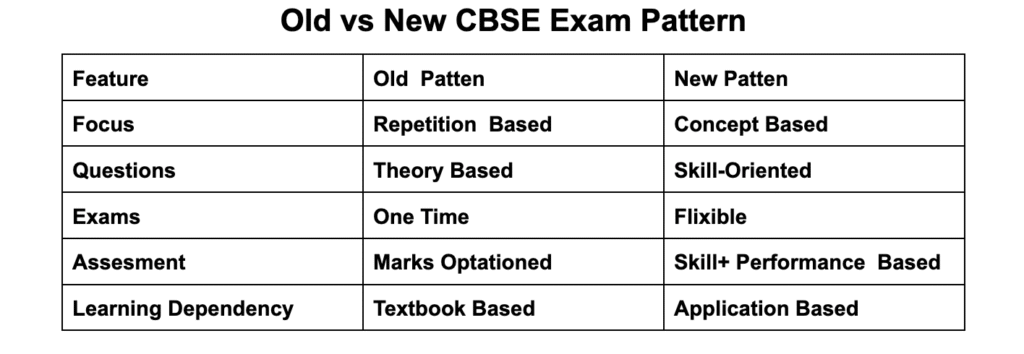
In the evolving landscape of the CBSE education system, it is crucial for students to shift away from rote memorization and focus on understanding and applying concepts. Instead of merely seeking immediate answers, students should concentrate on grasping the subject matter and engaging with case study-based and competency-based questions. Furthermore, analytical thinking and problem-solving abilities are essential for students, as examinations are designed to evaluate their capacity to apply knowledge to real-world scenarios. Excelling in internal assessments, projects, and assignments is vital for students, as these components are fundamental to their overall academic performance.
- Concentrate on grasping concepts
- Engage in case-study questions
- Enhance analytical reasoning
- Undertake projects and assignments
- Cultivate practical abilities
Future of CBSE Education System
The upcoming direction of the CBSE educational framework will emphasize flexibility, learner-centered approaches, and skill enhancement among its diverse objectives.
Shifting away from the traditional reliance on rote memorization, the CBSE is poised to refocus its attention on conceptual comprehension and practical skills to better prepare learners for their future pursuits and careers.
The full execution of the NEP 2020 will empower the CBSE system to offer a variety of choices, including multiple examination formats and interdisciplinary studies, while also integrating technologies such as AI and the internet.
Interdisciplinary studies, while also incorporating technologies like AI and the internet.
FAQs
- What is the biggest change in CBSE exams?
The most significant alteration is the transition from memorization-based learning to questions focused on competencies.
2. Will CBSE conduct board exams twice a year?
Yes, , the CBSE is considering the implementation of multiple attempts to alleviate stress.
3. Are CBSE exams becoming easier?
Not simpler — but rather more conceptual and pragmatic
4. What is competency-based education?
It emphasizes the comprehension and application of concepts instead of rote memorization
5. How should students prepare now?
Students ought to concentrate on understanding concepts clearly, engage in application-based question practice, and cultivate their analytical abilities.
Conclusion
The CBSE education system has witnessed a revolutionary change between the years 2020 and 2026. The emphasis in these reforms is clearly on holistic development, skill-building, and concept learning.
This revolution in education is not just limited to examinations; it is a revolution that seeks to redefine the Indian education system. Students who embrace this system will be ready to face future challenges.